Espresso — a chronicle of consented heteronomy
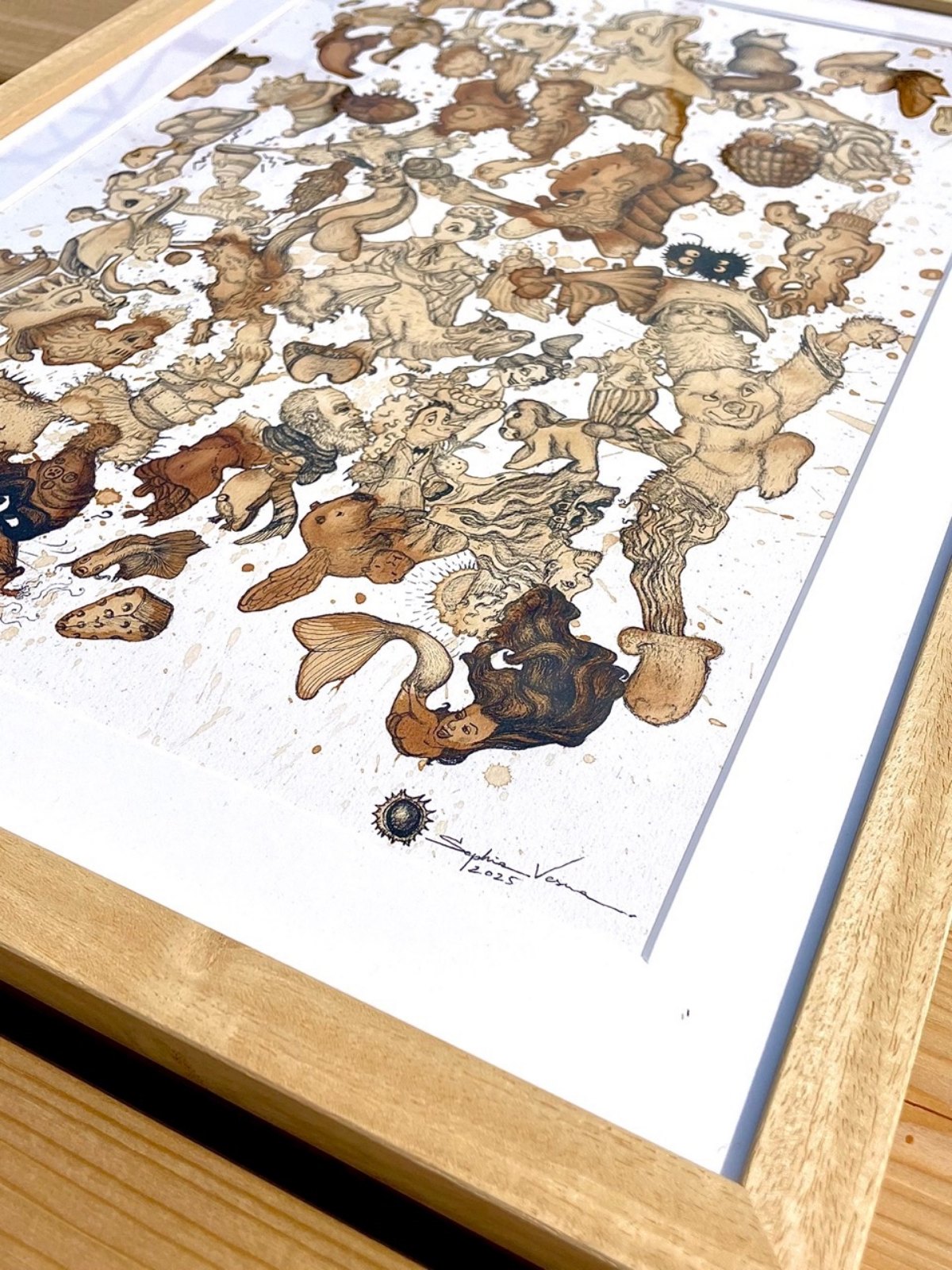
Every weekday at 7:30 a.m., Sophia Vesna switches on her streaming setup. The live will last three hours. On the table: an A5 sheet of watercolour paper, coffee, and a hundred or so people watching. It is here, since 2024, that Espresso is made — some fifty sheets to date, at a rhythm of one every two weeks. That time cannot be seen, yet it can be read everywhere, in the density of the figures as in the care given to the most thankless areas. The work begins at the first live and is finished only at the signature; the sheet keeps the whole memory of the “spect-actors” who helped create it.
The coffee is splashed live, before the audience. Nothing is prepared, nothing can be corrected. The material does not forgive, and neither does the live: two irreversibilities laid one over the other, the second redoubling the first. What chance deposits on the paper, no one — neither the artist nor the viewers — will ever see otherwise.
There is, in the choice of coffee, an obviousness we must refuse to find trivial. The morning slot, the cup: the material and the hour answer each other.
The collective
Then comes what sets this practice apart from all those it resembles: it is the viewers who propose. They look at the stain and say what they see in it — a bird, a teapot, an angry old man. This is pareidolia at work, the brain’s tendency to project the known onto the formless, the one that makes faces in electrical sockets and animals in clouds. Ordinarily solitary and fleeting, here it is public, verbalised, archived in the chat; it becomes an ode to the imagination.
What we observe then has something of stigmergy, that mode of coordination where each contribution modifies the environment and steers the ones that follow. A first reading is proposed; it suddenly makes certain forms visible and hides others; the second builds on the first, the third on both. The field of possibilities closes, suggestion after suggestion, without anyone having decided anything. It is a collective imagination in the proper sense — not the sum of individual imaginations, but a form that would exist in none of them taken alone.
Sophia Vesna arbitrates, and that is where everything is decided. The audience constantly pushes to overflow — a figure is always easier if you allow yourself one more stroke — but the rule, stated aloud during the lives, forbids it: everything that will appear had to be there already in the stain; nothing is added from without. This constraint of immanence founds a consented heteronomy in which the artist gives up almost everything to keep a single prerogative, that of saying no. A minimal and absolute power, enough to make a stream of suggestions a work rather than a poll. It produces losers, discarded readings that will never return, and a muted tension toward completion: the audience wants to see the thing finished while the artist works at the pace of what the stain consents to yield. For no stain is ever abandoned, and the thankless areas, those where no one sees anything, make the ends of sheets the slowest and most tense moment. One waits to find — and on a platform devoted to the abolition of dead time, that waiting is not a flaw of the format but the very condition of discovery, received by the audience as a value and a form of hospitality.
The filiation
The procedure has a name. Justinus Kerner, a German poet and doctor, published his Klecksographien in 1857: folded inkblots, turned into ghosts and creatures, accompanied by poems. He drew a method from it, which Hermann Rorschach would turn into a clinical instrument in 1921. Kerner remains the most exact kinship — the stain stays sovereign there, visible as such, and figuration is only an added reading. The difference is one of tone: Kerner folds, hence symmetry and a funereal register; Sophia splashes, hence asymmetry and comedy. Filiation by method, inversion of tone.
Upstream, Leonardo da Vinci already advised staring at stained walls to see battles in them. Victor Hugo, closer still by the material, stained his papers with coffee and grounds to bring forth castles and spectres. His friend George Sand practised, in the same period, what she called her dendrites: watercolour crushed between two sheets, from which she then drew forests and landscapes by following what chance had deposited. Same gesture, same renunciation of the prior project.
One might think of Pollock and tachism; one would be wrong: dripping seeks no figure. Here the work has two distinct moments, the stain then its reading, and it is that doubling that makes everything. In contemporary creation, there is Stefan Kuhnigk and his Coffeemonsters: coffee, monsters, the stain first. Or Giulia Bernardelli, who paints with coffee with a virtuosity that stages the overturned cup.
Fifty sheets reveal a trajectory. First the monochrome coloured pencil, tuned to the tone of the coffee — the drawing obeys the stain. Then the precision pen, black on sepia — the outline of the illustration asserts itself, lines finer, more contrasted. Then come two pieces on the theme of birds, watercolour and polychrome pencils, then trials on coloured inkblots: attempts at emancipation, departures from the original matrix. Today, a return to coffee, but in polychromy of coloured pencils.
The sheets circulate, and we must beware of taking them for mere relics of the live. They are looked at on their own, outside the story that produced them — it is on that condition, indeed, that they sell. On TikTok, live, sometimes before they are even finished: the collector then acquires an object whose final form is unknown, buys a process under way and trusts what will come out of it. Shown in 2025 at the Brûlerie de Bernay, where exhibiting coffee drawings in a place devoted to coffee is no coincidence.
Her website (sophiavesna.com) gives the most exact proof of it: on mouseover, each sheet sheds its drawing and returns to its first state, the immaculate stain. There, in a single gesture, one sees the work’s two moments — the matrix and its reading — an original, almost visionary way of making visible what the live alone left to be guessed.
The title of the series holds in this ambiguity: Espresso, the coffee and the expression, the material and what one draws from it. None of this claims any theory. The proposal has no ambition beyond a shared artistic moment, held each morning with constancy and kindness. That is precisely what makes it describable: it does not seek to justify itself, it is content to take place.
There would then be reason to file this practice under online entertainment — the vertical format, the chat’s participation, the live selling. That would be to miss the essential. What is at play at every live is a formal rule, publicly stated and held under the pressure of a hundred people who, without ill intent, spend three hours suggesting it might be loosened a little. Art surfaces in every corner of the page, and the finished sheets are the witness to it.
Read also on Maison Mujō: Sophia Vesna — artist profile, the interview “There’s no undo button in traditional art”, and Échos Graphite, her first exhibition. Watch it live on TikTok, Twitch, and sophiavesna.com.