2026 · 07 · interview · maison mujō
Sophia Vesna — “There’s no undo button in traditional art”
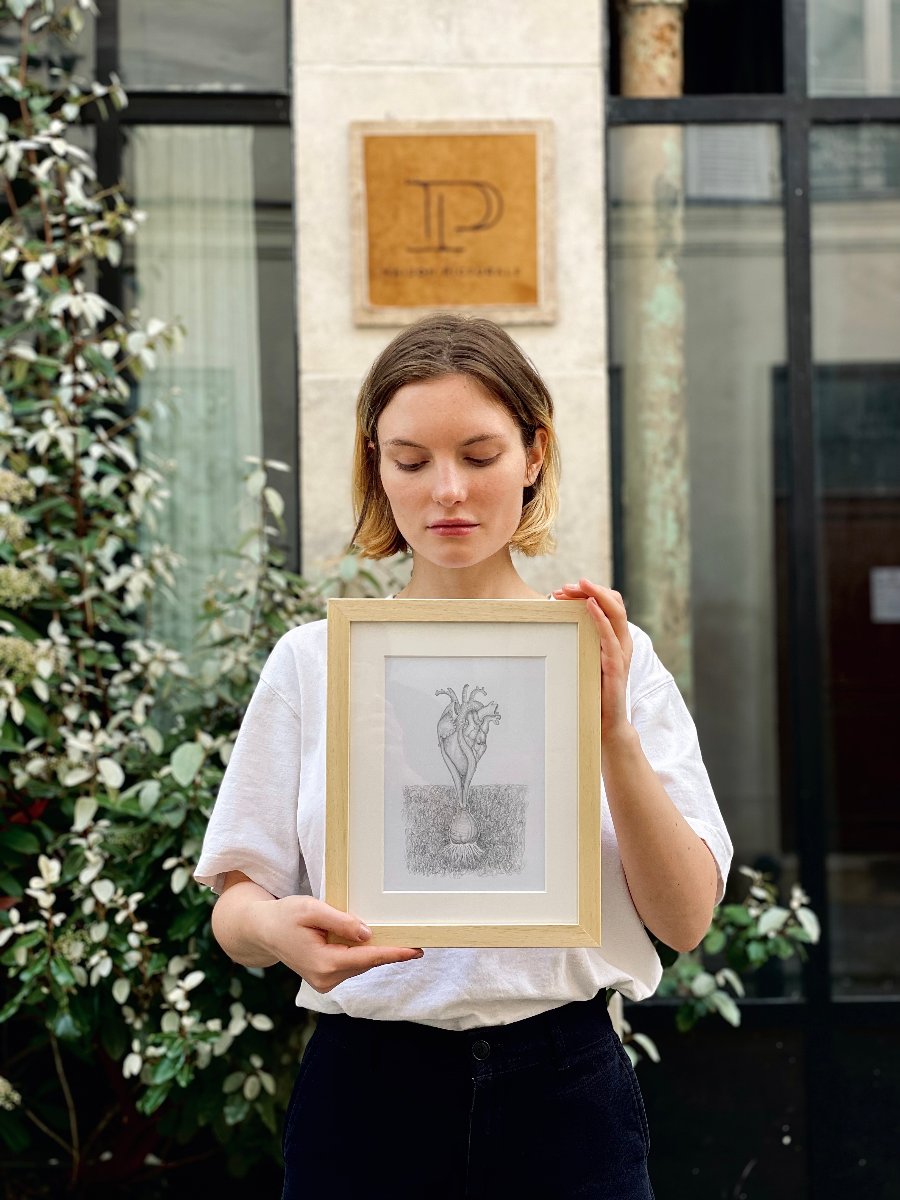
A multidisciplinary artist, Sophia Vesna has worked with Maison Mujō for several years, notably around her solo exhibitions — her full story lives on her artists page. Here, we wanted to return to her aspirations, her relationship to making, and the threads running through her work today.
Q: You’ve had many lives — acting, modelling, drawing. If each of these disciplines taught you one essential thing, what would it be?
I started modelling at six, and at that age it mostly took away my self-confidence. The pressure to always be “beautiful”, “thin” and “pleasant” created an unhealthy obsession in me, especially through my teenage years, when I went through severe acne. However much I tried to hide it, castings dried up, and my self-esteem hit rock bottom. Thankfully, acting helped me rebuild that confidence in my body and in myself, and I learned to stop being afraid of expressing myself in front of others. Drawing, which I’ve also practised since childhood, taught me to enjoy solitude — I dive in and never notice the time pass.
Q: How are your days structured now, as an artist?
For each project I keep a rigorous schedule that I try to follow to the letter. Monday to Wednesday I handle everything administrative — social media, outreach. Thursdays and Fridays are days of pure creation: I switch off my phone and don’t touch it all day; the world can wait. I can draw non-stop for eight or nine hours, and it’s only when I stop that I realise everything aches. I need to learn to take breaks, haha.
Q: Which part of the creative process is most exciting for you?
Adding colour and working the details! That’s the moment when everything comes to life — and also one of the most stressful. For instance: you’re working in watercolour, and if your brush loaded with black paint drops onto your beautiful blue-sky gradient, you have to try to erase the unerasable, or draw a big seagull to hide the disaster — it’s terrible, haha.
There’s no undo button in traditional art, unlike the digital.
Q: What is your relationship to digital art?
It’s a tool that saves a great deal of time, but I don’t practise it, and I don’t know if I ever will. On top of that, we’re already seeing artists have their singular touch copied by AI in a matter of seconds — and without an original physical object, what will be left of the artist’s work? I wonder whether those who work digitally won’t eventually return to traditional art, to recover something unique and physical.
Q: Is there a doubt, a fragility or a tension running through your work right now that directly shapes your artistic choices?
Depression, sadness and anger are often my engines. Diagnosed with ADD a few years ago, I felt both the relief of understanding that I’m neither lazy nor stupid — contrary to what I’d been taught to believe — and the torment of figuring out how to live with it, and the unwanted weight it places on the people close to me. I turn all of that into something beautiful and strange, expressing these emotions subtly and often with humour, whether through the imaginary characters of Espresso or the line work of my Textures collection.
Q: How would you describe your approach to creation — technically as well as aesthetically and philosophically?
Often, ideas come to me as images right as I’m falling asleep. I sketch them straight into my notebook so I can bring them back out at the right moment. These last few years have brought me many dark, anxious images, no doubt fed by current events. I can’t wait to put them on paper. I’m self-taught, and every day I learn by testing, by exploring different movements, drawing on artists around me or the masters of the past. I give myself the freedom to be wrong, to change direction if it no longer suits me, or on the contrary to go deeper into what I love until I reach my own “ideal”. I’m also trying, more and more, to own my dual Belarusian-Japanese culture in my work. For a long time I hid it, out of modesty and a wish to fit in, to fit the mould. But I realised that the more I own who I am, the simpler everything becomes. I think that’s precisely what interests people in what I do.
The more I own who I am, the simpler everything becomes.
Q: Which themes matter to you today, that you feel you need to explore in your coming collections?
It’s hard to stay unmoved when the world is burning — both literally and figuratively. What deeply concerns me is the violence human beings inflict on themselves and on nature in their endless pursuit of profit. We’re all part of it, consciously or not. Through my work I try to pose a question: how do we live with this reality once we’re aware of it? And what could we do better, as humans, for our planet.
Q: Are there techniques, materials or formats you haven’t explored yet that especially draw you?
No shortage of desires! I’d love to work gold leaf into my watercolours, paint murals, and collaborate with brands so my illustrations adorn their products — perfumes, clothes, furniture and so on. But concretely, I’m already deep into a new challenge: an autobiographical graphic novel about the childhood of a little Belarusian girl in Japan, confronted with existential questions tied to being constantly reminded of her difference by both societies. It was in telling these anecdotes to my friends in France — convinced they were universal — that I realised my experience was perhaps less ordinary than I thought. And that this story might resonate with someone, one day. If I’m starting now, it’s also because certain situations I’ve lived in France bring me back to that period, and I felt the timing was right.
Q: Could you name a work and a moment in your career you’re especially proud of?
To date, it’s clearly Suikomu — “to inhale / to draw in” in Japanese. While organising my first exhibition, Échos Graphite, made up of some thirty A5 graphite works, I decided at the last minute to add one large A2 drawing. I had only two weeks left to conceive the idea, make sketches and tests, order the frame and produce the piece. It was one of the best decisions of my life: the drawing sold a few days after the opening. In it, I imagined a world being drawn into a gigantic black hole, until nothing remained but the viewer. Through perspective, the work breaks the fourth wall: the onlooker understands they will be the next and final thing to be swallowed. I wanted to evoke a feeling of solitude, anguish and powerlessness. Of course, art is subjective… and some people saw a hot-air balloon. That works too, haha.